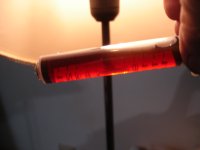
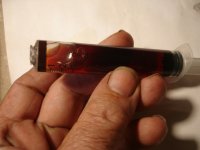
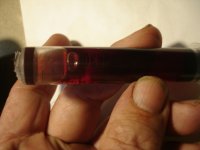
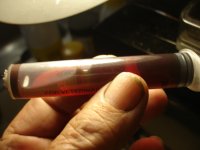
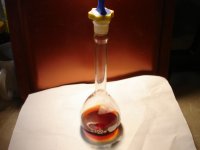
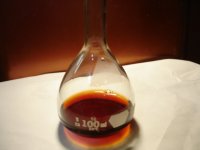
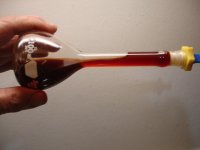
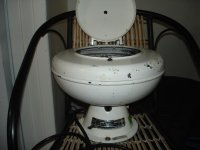
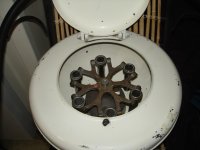
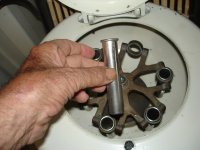
I just ran into a used centrifuge...at a flea market today.... its an older one...it feels like it weighs 40 or 50 lbs! .... Its marked ....... [university of colorado med center .[ lab].......Must be a good one.. it has 6 metal tubes to put specimens in .... some of their older equipment i guess...
When i turn it on it starts slow ... but when turned up it goes to warp speed! so fast its a blurr! ....its not a home made device...
I believe i can just buy clear plastic or glass sample tubes ..that fit]... and remove the larger metal tubes...
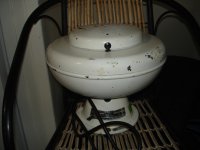
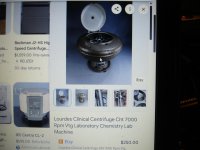
Ill send a picture of the machine...
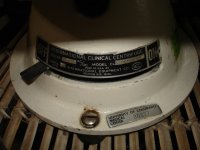
The last smaller picture looks very much like the machine i have with the slide speed control....zoom picture to read words..
i read this...
hese are results for
can a fast centrifuge separate a drug from powdered bark and remove plant fats in a naphtha solvent
Search instead for
can a fast centrifuge seperate a drug from powdered bark and remove plant fats in a napatha solvent
computer generated answer....
AI Overview
Yes, a fast centrifuge can be used in the process to separate a drug from powdered bark and remove plant fats in a naphtha solvent, but it is not a one-step solution
. Centrifugation is a mechanical separation technique that complements the solvent extraction process by speeding up the physical separation of components.
How a centrifuge helps
The solvent extraction process works by dissolving desired compounds, like a drug, along with undesirable ones, like fats, into a solvent. Because these compounds have different densities and properties, a centrifuge can accelerate their separation.
- Separating solid from liquid: After soaking the powdered bark in naphtha, the mixture will contain solid plant matter and the naphtha solvent with dissolved compounds. The first use for a centrifuge is to spin this mixture at high speed, forcing the solid, heavier bark particles to the bottom of the container. This allows the liquid extract to be decanted (poured off) or siphoned, separating it from the bulk of the solid plant waste.
- Separating fats from the extract:Plant fats (lipids) have a different density than the naphtha solvent and the drug compound. The specific effect of centrifugation depends on the relative densities:
- If the fats are less dense than the naphtha and the drug, they will float to the top of the liquid mixture during centrifugation.
- If the fats are more dense, they will form a pellet or a layer at the bottom of the container.
- Breaking emulsions: In some extractions, fats can form a stable emulsion with the solvent, making the mixture cloudy and difficult to separate. A fast centrifuge can apply sufficient force to break this emulsion, allowing the distinct layers to separate for easier collection.
Limitations of using only a centrifuge
While powerful, a centrifuge is not a magic bullet. For a complex mixture like powdered bark extract, other purification steps are necessary to get a pure final product.
- Non-selective extraction: Naphtha, being a non-polar solvent, will dissolve all non-polar compounds from the bark, including the desired drug, fats, waxes, and other lipids. The centrifuge separates based on density, but if the drug and the fats have similar densities, centrifugation alone will not be effective at isolating them.
- Other methods needed: Other techniques, such as chromatography, fractional freezing, or solvent-solvent extraction, are needed to fully purify the drug from the fats and other compounds with similar densities.
Summary of the process
A more complete and realistic extraction and purification process might look like this:
- Solvent Extraction: Soak the powdered bark in naphtha to dissolve the target drug and other non-polar compounds, including fats.
- Initial Separation: Centrifuge the bark/naphtha mixture. The powdered bark pellets at the bottom, and the liquid containing the drug and fats can be collected.
- Fat Removal: Subject the liquid extract to a second centrifugation step to separate the fats, which will either float or pellet out depending on their density.
- Further Purification: Use a more selective method, such as liquid-liquid extraction with a different solvent or chromatography, to isolate the drug from any remaining impurities.
- A single centrifugation method for isolating fat droplets from ...
We utilized two properties conferred by the fat core of FDs to fractionate them away from the cytosol and sedimentable organelles. First, because FDs lack an aq...
National Institutes of Health (NIH) | (.gov)
- Techniques for extraction and isolation of natural products
Apr 17, 2018 — Extraction is the first step to separate the desired natural products from the raw materials. Extraction methods include solvent extraction, distillation method...
National Institutes of Health (NIH) | (.gov)
- Comparison of Techniques and Solvents on the Antimicrobial ...
Four extraction methods (solid-liquid, ultrasound, Soxhlet, and microwave) and six solvents (water, methanol, ethanol, acetone, dichloromethane, and hexane) wer...
National Institutes of Health (NIH) | (.gov)
Show all
[[can a centrifuge be used to separate out impurities from an organic drug??
Yes, a centrifuge can be used to separate impurities from an organic drug, particularly when the impurities have a different density or size than the desired product
. The effectiveness of centrifugation depends on the state of the substances you want to separate—specifically, whether the impurities are solid particles suspended in a liquid or are part of a mixture of different density fluids.
How it works for organic drug purification
The process is an excellent option for certain types of separation and is often used in combination with other purification methods.
- Separation based on density: A centrifuge separates components in a mixture by spinning them at high speed. The resulting centrifugal force causes the denser particles to move toward the bottom of the container, forming a pellet, while the lighter components remain in the liquid supernatant.
- Separating solids from liquids: If your organic drug is dissolved in a solvent and the impurities are undissolved solids (like salts, catalysts, or precipitates from a crystallization), a centrifuge can spin these solid particles to the bottom of the tube for easy removal.
- Purifying crystallized products: In pharmaceutical manufacturing, centrifuges are used to separate crystallized drug substances from the "mother liquor," which contains remaining impurities and solvent. This is a critical step for isolating the bulk drug.
- Removing particulate matter: For injectable drugs or other formulations that require high purity, centrifuges can remove fine particulate matter that is too small for standard filtration.
Limitations for organic drugs
Centrifugation is a highly effective, but not universal, purification technique. Its usefulness is dependent on the properties of the mixture.
- Solubility and density are key: The method is most effective when the desired drug and the impurities have significant differences in density. If the impurities and the drug have similar densities, a centrifuge alone may not be able to separate them.
- Does not remove dissolved impurities: Centrifugation is not effective for removing impurities that are dissolved in the same solvent as the drug. It can only separate components that are physically distinct (e.g., a solid from a liquid).
- Other techniques may be needed: Many organic synthesis and purification processes require other techniques to get a high-purity product. For example, after an initial centrifugation to remove solid particles, additional methods like chromatography, distillation, or recrystallization may be necessary to remove dissolved impurities.
Combined purification techniques
Centrifugation is often a single step in a broader purification process.
- Centrifugal filtration: This technique combines the use of a semi-permeable membrane with centrifugal force to separate particles based on size and molecular weight.
- Recrystallization and centrifugation: For solid products, an organic drug is often dissolved, crystallized to precipitate the pure product, and then centrifuged to isolate the solid crystals from the liquid impurities.
- Centrifugation for sample preparation: In analytical chemistry, a centrifuge is frequently used to prepare samples for more advanced analysis techniques like mass spectrometry or chromatography, ensuring the sample is free of interfering particulate matter.
AI responses may include mistakes.
Learn more
16 sites
- Centrifuges Used in Pharmaceutical Manufacturing
Feb 24, 2025 — Centrifuges Used in Pharmaceutical Manufacturing. ... The pharmaceutical industry relies on precise and efficient centrifuges to meet the exacting standards of ...
www.westernstates.com
- Purification Via Centrifugation: Method for Separating ...
Dec 23, 2022 — Purification Via Centrifugation: A Quick and Efficient Method for Separating Substances * When it comes to separating substances, there are several methods that...
Zuiveringstechnieken
- A Review on Centrifugation in the Pharmaceutical Industry
A Review on Centrifugation in the Pharmaceutical Industry. ... Correspondence to: Stephen Olaribigbe Majekodunmi, Department of Pharmaceutics and Pharmaceutical...
Scientific & Academic Publishing
Show all









 )
)