Coding the DMT Experience
Looking for help from experienced Nexus members
5 minute read.
TL;DR
I have a large and growing corpus of DMT reports, primarily my own longitudinal first-person reports, along with secondary reports and observations I've collected over 30 years. I want to develop a coding system that lets me compare these experiences without losing the original language or chronology.
The basic idea is to take a trip report—which is essentially a story—and extract what was experienced, what followed what, and how one thing became another.
In simple terms:
TRIP REPORT → STATES → TRANSITIONS → TEMPORAL TRACE
There are three things I'm interested in:
SEQUENCE IS DATA — What tends to happen next?
THE ARROW IS DATA — How did one experienced state become another?
HISTORY MAY BE DATA — Does where the experience goes next depend partly on the route already traveled?
Before I start seriously coding my archive, I'd like some help from experienced people here. What are the right nouns and verbs of the DMT experience? What am I missing? What recurring transitions do you recognize from your own experiences?
What I mean by “coding”
The core of this project is my own growing longitudinal archive. I've accumulated a large number of first-person reports ranging from detailed, immediate accounts to shorter notes, along with dosing and technical information, setting, music, physical observations and other variables. I've also been collecting secondary reports and observations that may eventually provide useful comparisons.
The amount of material is getting large enough that reading individual reports isn't the problem anymore. Comparing them is.
I want to build an analytical layer on top of the original reports. The original language stays intact.
Suppose a report says:
“The pattern started to thicken and fold into itself. It became increasingly three-dimensional until suddenly I realized I wasn't looking at the geometry anymore. I was inside it. Then the whole thing exploded outward into a completely formed space.”
As prose, that's a trip report.
For analysis, I might extract the nouns or states:
GEOMETRY → RECURSIVE STRUCTURE → SPATIAL DEPTH → IMMERSION → ENVIRONMENT
Then the verbs describing how those states changed:
THICKEN → FOLD → RECURSE → EMBED → EXPLODE
That gives me something like:
GEOMETRY --[THICKEN + FOLD + RECURSE]→ SPATIAL STRUCTURE --[EMBED]→ IMMERSION --[EXPLODE]→ ENVIRONMENT
Do that across hundreds of reports and I potentially have something very different from a pile of stories. Reports written months or years apart, or reports using completely different language, might contain comparable phenomenological structures.
The original story remains the primary data. The coded version gives me something I can compare across the archive.
That's what I mean by coding.
The nouns
The first problem is deciding what actually belongs in the vocabulary.
A very provisional list might include SOMATIC/BODY, AUDITORY, GEOMETRY, RECURSION/RECURSIVE STRUCTURE, SELF-SIMILARITY, SPATIALIZATION, IMMERSION, ENVIRONMENT, ENTITY, PERCEIVED PRESENCE/AGENCY, SIGNAL, INFORMATION/DOWNLOAD, SELF-LOSS, BODY RETURN, IDENTITY RETURN, PLACE/ROOM RECOGNITION, and RECONSTRUCTION.
Some of these overlap. Some are probably too broad. ENTITY and PERCEIVED PRESENCE, for example, may turn out to require very different coding. SIGNAL and INFORMATION/DOWNLOAD are particularly slippery because they may describe something quite different from visual content or spatial organization.
Some may not really be “states” at all. They may eventually become dimensions, events or features that can coexist within a larger state.
I'm not trying to settle that in advance. That's partly why I'm asking.
The verbs
This is the part I'm especially interested in.
Two reports might both contain:
GEOMETRY → ENVIRONMENT
But those arrows could describe completely different experiences.
One person might describe geometry gradually gaining depth, folding into itself and becoming architecture. Another might describe geometry, then a sudden POP, then a complete room.
Same crude starting point. Same crude destination. Different transition.
So far, some possible transition verbs are:
MORPH — one form gradually becomes another.
EMERGE — something becomes progressively apparent without necessarily transforming from something else.
RESOLVE — something ambiguous becomes recognizable or interpretable.
REPLACE — one state disappears and another appears with little experienced continuity.
EMBED — going from looking at something to being spatially inside it.
FOLD — a surface, space or structure appears to fold into itself or into another arrangement.
RECURSE — a structure repeats or nests within itself.
PIXELATE — something apparently continuous breaks into discrete blocks, cells, points or units.
EXPLODE — a form or scene rapidly expands, fragments or bursts into multiple components.
OVERLAY — one percept, scene, structure or informational layer appears over or through another while both remain present.
SUPERPOSE — two or more perspectives, scenes or temporal frames are experienced simultaneously.
MULTIPLEX — several viewpoints, perceptual streams or experiential channels appear to operate at the same time.
BIFURCATE — a previously unitary viewpoint or experiential stream appears to split into two or more perspectives.
DUPLICATE — the same object, scene or structure appears simultaneously in more than one location, perspective or representation.
TEMPORALLY OVERLAY — two or more apparent moments are experienced together, as though different points in time have been laid over one another.
COLLAPSE — an organized structure loses coherence.
OVERRIDE — ordinary perceptual or self/world organization is abruptly displaced.
RECONSTRUCT — ordinary body, identity, place or orientation progressively reassert themselves.
I don't expect these to remain cleanly separated. A transition could be MORPH + EMBED, COLLAPSE + REPLACE, or BIFURCATE + TEMPORALLY OVERLAY.
There are probably important differences hiding inside some of these words too. Is the percept duplicated, does the viewpoint split, are several streams running simultaneously, or do two apparent moments coexist? Those may eventually need separate codes.
And there always needs to be OTHER, UNKNOWN, or NEW CATEGORY, because I don't want to force the reports into the model just to make the coding neat.
Sequence is data
Order may contain information that a normal content inventory loses.
Consider:
GEOMETRY → IMMERSION → PRESENCE → FEAR
versus:
FEAR → GEOMETRY → IMMERSION → PRESENCE
Both reports might receive exactly the same content labels: geometry, immersion, presence, fear.
But they're not the same experience.
So rather than only asking “What did I experience?”, I want to start asking “What happened next?”
Across enough reports, I may eventually be able to look for recurring transitions such as GEOMETRY → IMMERSION, IMMERSION → ENVIRONMENT, ENVIRONMENT → PRESENCE, or GEOMETRY → RETURN.
I'm not proposing a universal DMT itinerary. The first job is simply to find out whether recurring sequences exist in the material and whether I have enough temporal information in the old reports to recover them reliably.
The arrow is data
Knowing A became B still leaves something out:
How did A become B?
Did it morph, emerge, resolve, fold, recurse, pixelate, explode, overlay, superpose, bifurcate or get replaced? Did I go from looking at something to being inside it? Did several viewpoints appear simultaneously? Did two moments seem to coexist? Did a structure gradually assemble, or was it suddenly just there?
This is why I'm interested in the verbs.
States are the nouns. Transitions are the verbs.
Two experiences may arrive at what looks like the same state by completely different routes.
History may be data
This is the most speculative part.
Suppose two reports arrive at what I've coded as the same state, X. One gets there through A → B → X, while another gets there through C → D → X.
Does X behave the same way afterward?
Maybe.
But perhaps the route already traveled changes what tends to happen next. Or perhaps, if X consistently behaves differently depending on how I got there, that's evidence that my category X is too crude and I've combined two phenomenologically different states.
Either result is useful.
I'm especially interested in this during return.
Trip reports can devote pages to entry and the peak and then finish with: “And then I came back.”
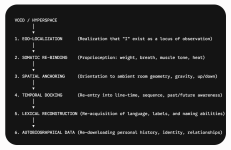
But what actually came back, and in what order? Body, identity, recognition of the room, ordinary space, time, language, autobiographical memory, social awareness? Do they all return together, or does ordinary consciousness reconstruct itself in stages?
I suspect “then I came back” may be hiding a lot of useful phenomenological information.
Where AI fits into this
I'm using AI mainly because of the volume of material. It can help search reports, extract candidate states and sequences, compare descriptions written months apart, and help me develop and test the coding vocabulary.
It's useful because it can keep much more of the notebook open at once than I can.
It can also confidently infer things that aren't actually in the source.
So my rule is simple:
AI proposes. Original text decides.
If an old report says, “Strong visuals, heavy body load, Buddha, peaceful return,” I can't automatically turn that into BODY → VISUALS → BUDDHA → RETURN unless the report actually establishes that order.
If the chronology isn't there, it stays UNKNOWN.
I'm not trying to use a large dataset and AI to manufacture answers. I'm trying to use them to manufacture better questions.
What I'm asking from the Nexus
Before I start applying a fixed vocabulary across my archive, I'd like people here to help poke holes in it.
I'm particularly interested in people with substantial DMT experience who recognize recurring structures in their own reports.
What nouns am I missing? What verbs am I missing?
Do things fold, pixelate, recurse, inflate, invert, crystallize, assemble, unfold, snap, open, swallow, rotate into place, superpose, bifurcate, duplicate or multiplex?
Do you experience several viewpoints at once? Can you apparently see the same thing from two places simultaneously? Do two different moments seem to coexist? Does the experience sometimes feel layered rather than sequential?
Is there something that happens repeatedly in your experiences for which ordinary English doesn't even have a particularly good verb?
Are SIGNAL and INFORMATION/DOWNLOAD useful categories, or are those already interpretations of something more basic that should be coded differently?
Does an ENTITY appear, emerge, assemble, resolve out of something else, reveal itself as already present, overlay another structure, or arrive in some other way?
And what happens on the way back? Is there any recognizable order to the return of body, identity, place, time, language and memory?
I'm not asking anyone to force their experiences into my vocabulary. Quite the opposite.
If you've had fifty experiences containing a transition this scheme can't describe, that's exactly what I'm looking for.
The aim is to develop the vocabulary before I seriously code the corpus, then use it to turn hundreds of separate stories into something I can compare without destroying the original reports that gave me the data.
SEQUENCE IS DATA — What tends to happen next?
THE ARROW IS DATA — How did it get there?
HISTORY MAY BE DATA — Does the route already traveled affect where it goes next?
Or more simply:
States tell me what was there. Sequences tell me where it went. Transitions tell me how it moved. History may tell me why apparently similar states don't always go to the same place next.
If this sounds interesting and you'd like to help build, criticize or break the vocabulary before I start applying it to the archive, let me know.
PLUR
Q[/EMBED]
Looking for help from experienced Nexus members
5 minute read.
TL;DR
I have a large and growing corpus of DMT reports, primarily my own longitudinal first-person reports, along with secondary reports and observations I've collected over 30 years. I want to develop a coding system that lets me compare these experiences without losing the original language or chronology.
The basic idea is to take a trip report—which is essentially a story—and extract what was experienced, what followed what, and how one thing became another.
In simple terms:
TRIP REPORT → STATES → TRANSITIONS → TEMPORAL TRACE
There are three things I'm interested in:
SEQUENCE IS DATA — What tends to happen next?
THE ARROW IS DATA — How did one experienced state become another?
HISTORY MAY BE DATA — Does where the experience goes next depend partly on the route already traveled?
Before I start seriously coding my archive, I'd like some help from experienced people here. What are the right nouns and verbs of the DMT experience? What am I missing? What recurring transitions do you recognize from your own experiences?
What I mean by “coding”
The core of this project is my own growing longitudinal archive. I've accumulated a large number of first-person reports ranging from detailed, immediate accounts to shorter notes, along with dosing and technical information, setting, music, physical observations and other variables. I've also been collecting secondary reports and observations that may eventually provide useful comparisons.
The amount of material is getting large enough that reading individual reports isn't the problem anymore. Comparing them is.
I want to build an analytical layer on top of the original reports. The original language stays intact.
Suppose a report says:
“The pattern started to thicken and fold into itself. It became increasingly three-dimensional until suddenly I realized I wasn't looking at the geometry anymore. I was inside it. Then the whole thing exploded outward into a completely formed space.”
As prose, that's a trip report.
For analysis, I might extract the nouns or states:
GEOMETRY → RECURSIVE STRUCTURE → SPATIAL DEPTH → IMMERSION → ENVIRONMENT
Then the verbs describing how those states changed:
THICKEN → FOLD → RECURSE → EMBED → EXPLODE
That gives me something like:
GEOMETRY --[THICKEN + FOLD + RECURSE]→ SPATIAL STRUCTURE --[EMBED]→ IMMERSION --[EXPLODE]→ ENVIRONMENT
Do that across hundreds of reports and I potentially have something very different from a pile of stories. Reports written months or years apart, or reports using completely different language, might contain comparable phenomenological structures.
The original story remains the primary data. The coded version gives me something I can compare across the archive.
That's what I mean by coding.
The nouns
The first problem is deciding what actually belongs in the vocabulary.
A very provisional list might include SOMATIC/BODY, AUDITORY, GEOMETRY, RECURSION/RECURSIVE STRUCTURE, SELF-SIMILARITY, SPATIALIZATION, IMMERSION, ENVIRONMENT, ENTITY, PERCEIVED PRESENCE/AGENCY, SIGNAL, INFORMATION/DOWNLOAD, SELF-LOSS, BODY RETURN, IDENTITY RETURN, PLACE/ROOM RECOGNITION, and RECONSTRUCTION.
Some of these overlap. Some are probably too broad. ENTITY and PERCEIVED PRESENCE, for example, may turn out to require very different coding. SIGNAL and INFORMATION/DOWNLOAD are particularly slippery because they may describe something quite different from visual content or spatial organization.
Some may not really be “states” at all. They may eventually become dimensions, events or features that can coexist within a larger state.
I'm not trying to settle that in advance. That's partly why I'm asking.
The verbs
This is the part I'm especially interested in.
Two reports might both contain:
GEOMETRY → ENVIRONMENT
But those arrows could describe completely different experiences.
One person might describe geometry gradually gaining depth, folding into itself and becoming architecture. Another might describe geometry, then a sudden POP, then a complete room.
Same crude starting point. Same crude destination. Different transition.
So far, some possible transition verbs are:
MORPH — one form gradually becomes another.
EMERGE — something becomes progressively apparent without necessarily transforming from something else.
RESOLVE — something ambiguous becomes recognizable or interpretable.
REPLACE — one state disappears and another appears with little experienced continuity.
EMBED — going from looking at something to being spatially inside it.
FOLD — a surface, space or structure appears to fold into itself or into another arrangement.
RECURSE — a structure repeats or nests within itself.
PIXELATE — something apparently continuous breaks into discrete blocks, cells, points or units.
EXPLODE — a form or scene rapidly expands, fragments or bursts into multiple components.
OVERLAY — one percept, scene, structure or informational layer appears over or through another while both remain present.
SUPERPOSE — two or more perspectives, scenes or temporal frames are experienced simultaneously.
MULTIPLEX — several viewpoints, perceptual streams or experiential channels appear to operate at the same time.
BIFURCATE — a previously unitary viewpoint or experiential stream appears to split into two or more perspectives.
DUPLICATE — the same object, scene or structure appears simultaneously in more than one location, perspective or representation.
TEMPORALLY OVERLAY — two or more apparent moments are experienced together, as though different points in time have been laid over one another.
COLLAPSE — an organized structure loses coherence.
OVERRIDE — ordinary perceptual or self/world organization is abruptly displaced.
RECONSTRUCT — ordinary body, identity, place or orientation progressively reassert themselves.
I don't expect these to remain cleanly separated. A transition could be MORPH + EMBED, COLLAPSE + REPLACE, or BIFURCATE + TEMPORALLY OVERLAY.
There are probably important differences hiding inside some of these words too. Is the percept duplicated, does the viewpoint split, are several streams running simultaneously, or do two apparent moments coexist? Those may eventually need separate codes.
And there always needs to be OTHER, UNKNOWN, or NEW CATEGORY, because I don't want to force the reports into the model just to make the coding neat.
Sequence is data
Order may contain information that a normal content inventory loses.
Consider:
GEOMETRY → IMMERSION → PRESENCE → FEAR
versus:
FEAR → GEOMETRY → IMMERSION → PRESENCE
Both reports might receive exactly the same content labels: geometry, immersion, presence, fear.
But they're not the same experience.
So rather than only asking “What did I experience?”, I want to start asking “What happened next?”
Across enough reports, I may eventually be able to look for recurring transitions such as GEOMETRY → IMMERSION, IMMERSION → ENVIRONMENT, ENVIRONMENT → PRESENCE, or GEOMETRY → RETURN.
I'm not proposing a universal DMT itinerary. The first job is simply to find out whether recurring sequences exist in the material and whether I have enough temporal information in the old reports to recover them reliably.
The arrow is data
Knowing A became B still leaves something out:
How did A become B?
Did it morph, emerge, resolve, fold, recurse, pixelate, explode, overlay, superpose, bifurcate or get replaced? Did I go from looking at something to being inside it? Did several viewpoints appear simultaneously? Did two moments seem to coexist? Did a structure gradually assemble, or was it suddenly just there?
This is why I'm interested in the verbs.
States are the nouns. Transitions are the verbs.
Two experiences may arrive at what looks like the same state by completely different routes.
History may be data
This is the most speculative part.
Suppose two reports arrive at what I've coded as the same state, X. One gets there through A → B → X, while another gets there through C → D → X.
Does X behave the same way afterward?
Maybe.
But perhaps the route already traveled changes what tends to happen next. Or perhaps, if X consistently behaves differently depending on how I got there, that's evidence that my category X is too crude and I've combined two phenomenologically different states.
Either result is useful.
I'm especially interested in this during return.
Trip reports can devote pages to entry and the peak and then finish with: “And then I came back.”
But what actually came back, and in what order? Body, identity, recognition of the room, ordinary space, time, language, autobiographical memory, social awareness? Do they all return together, or does ordinary consciousness reconstruct itself in stages?
I suspect “then I came back” may be hiding a lot of useful phenomenological information.
Where AI fits into this
I'm using AI mainly because of the volume of material. It can help search reports, extract candidate states and sequences, compare descriptions written months apart, and help me develop and test the coding vocabulary.
It's useful because it can keep much more of the notebook open at once than I can.
It can also confidently infer things that aren't actually in the source.
So my rule is simple:
AI proposes. Original text decides.
If an old report says, “Strong visuals, heavy body load, Buddha, peaceful return,” I can't automatically turn that into BODY → VISUALS → BUDDHA → RETURN unless the report actually establishes that order.
If the chronology isn't there, it stays UNKNOWN.
I'm not trying to use a large dataset and AI to manufacture answers. I'm trying to use them to manufacture better questions.
What I'm asking from the Nexus
Before I start applying a fixed vocabulary across my archive, I'd like people here to help poke holes in it.
I'm particularly interested in people with substantial DMT experience who recognize recurring structures in their own reports.
What nouns am I missing? What verbs am I missing?
Do things fold, pixelate, recurse, inflate, invert, crystallize, assemble, unfold, snap, open, swallow, rotate into place, superpose, bifurcate, duplicate or multiplex?
Do you experience several viewpoints at once? Can you apparently see the same thing from two places simultaneously? Do two different moments seem to coexist? Does the experience sometimes feel layered rather than sequential?
Is there something that happens repeatedly in your experiences for which ordinary English doesn't even have a particularly good verb?
Are SIGNAL and INFORMATION/DOWNLOAD useful categories, or are those already interpretations of something more basic that should be coded differently?
Does an ENTITY appear, emerge, assemble, resolve out of something else, reveal itself as already present, overlay another structure, or arrive in some other way?
And what happens on the way back? Is there any recognizable order to the return of body, identity, place, time, language and memory?
I'm not asking anyone to force their experiences into my vocabulary. Quite the opposite.
If you've had fifty experiences containing a transition this scheme can't describe, that's exactly what I'm looking for.
The aim is to develop the vocabulary before I seriously code the corpus, then use it to turn hundreds of separate stories into something I can compare without destroying the original reports that gave me the data.
SEQUENCE IS DATA — What tends to happen next?
THE ARROW IS DATA — How did it get there?
HISTORY MAY BE DATA — Does the route already traveled affect where it goes next?
Or more simply:
States tell me what was there. Sequences tell me where it went. Transitions tell me how it moved. History may tell me why apparently similar states don't always go to the same place next.
If this sounds interesting and you'd like to help build, criticize or break the vocabulary before I start applying it to the archive, let me know.
PLUR
Q[/EMBED]