• Members of the previous forum can retrieve their temporary password here, (login and check your PM).

Instant ayahuasca little lightening bolt TEK

Migrated topic.
This looks like a very promising method for pharmahuasca, it feels wasteful to me to use pure extracted DMT for it. In a few weeks I'll be in a rural area without access to (clean) non-polar solvents and very very rudimentary equipment, so I'll likely be trying it.

Is there a reason lime should be used, besides the "off-the-grid" nature of the tek mentioned at some point in this thread? Could lye or sodium carbonate be substituted for it?

Also, I recently discovered by accident the precipitation of tannins after freezing mentioned in this thread. I'll be trying some freeze-thaw-decant cycles in the future.
 
Is there a reason lime should be used, besides the "off-the-grid" nature of the tek mentioned at some point in this thread? Could lye or sodium carbonate be substituted for it?
If you use lye then you would be making an alcohol base soup, so you wouldn't be able to get the DMT out of it without nps. By adding the lime to the alcohol tincture, a lime layer and DMT-alcohol will form automatically, so you can pipette off the alcohol layer.
No idea re: sodium carbonate.
 
So, I finally got around to transferring the DMT ethanol layer from the lime layer and evaporating the alcohol (see post #153 above).
See pics attached for the result. It's brown and goo-ish, as expected.

Not sure how much DMT is in there, hard to weigh sticky goo. I plan to redissolve the goo in a small amount of alcohol, then weigh the solution and subtract the weight of the pure alcohol and the container it is in-- although I still won't know how much of that weight is actual DMT vs plant matter. Will update once I've done so. Then I will probably add mullein to turn it into enhanced leaf.

Has something happened to Transform? Anybody know if he will be returning to the forum?
Update:

Total weight of the goo was 1,1g, so a 1,1% yield (though probably not all of the goo is actual DMT?). Not bad, but the yield with my usual tek (STB at room temperature) gave better results on this batch of bark, about 25-30% better in terms of yield (most of which was crystals).

Personally I'm done with this lime tek; it's expensive, gives lesser yields and the DMT goo is hard weigh and dose etc. But it does feel nice to know that the lime tek exists if ever NPS etc. become unavailable.
 
Since Sodium carbonate isn't very soluble in IPA, I'm trying to mix and remove some Sodium Carbonate to see if it grabs any undesired compounds. In another batch, I also tried just very salty saltwater, hoping some undesired parts might get trapped in the saltwater, which separates from the alcohol with some patience (see video:
). These are just stabs in the dark, so maybe Transform can lmk if these are futile efforts to get closer to pure DMT.
I failed to notice, at the time, just how useful a sodium carbonate treatment could be for separating water from a "TnT" lime-detanninized MHRB tincture.

This step most definitely requires more tests. It would be rather handy to boost the ABV of the tincture without hard freezing - the fiddling around to separate the ice crystals is rather tedious.

An important footnote here is that sodium carbonate will react with any dissolved lime to produce sodium hydroxide, while precipitating chalk.
 

Some differences of how I've made it when compared to this document (whose existence I had forgotten).
  • I used 10ml alcohol per gram of Mimosa
  • I had it soaking for about six hours instead of five days. I did a second soak with an additional 100ml vodka for another six hours in case there was still DMT remaining. It only got a little bit of color, so I don't know if it was worth it. Now, I may have wasted a lot of actives, but I don't think it's more wasteful than a traditional brew, as the potency was similar.
  • I used WAY less lime. I didn't measure it but seeing the huge layers in the pictures, it had to be much less. The first time the calcium tannate and lime (mostly lime that first time) layer thickness was about two thirds the vodka layer, and the second time it was somewhat thicker. So I probably used less than half the amount.
Despite these differences, the tincture was active and equivalent in potency to a traditional brew. The color was less orange, more yellow.
 
Some differences of how I've made it when compared to this document (whose existence I had forgotten).
  • I used 10ml alcohol per gram of Mimosa
  • I had it soaking for about six hours instead of five days. I did a second soak with an additional 100ml vodka for another six hours in case there was still DMT remaining. It only got a little bit of color, so I don't know if it was worth it. Now, I may have wasted a lot of actives, but I don't think it's more wasteful than a traditional brew, as the potency was similar.
  • I used WAY less lime. I didn't measure it but seeing the huge layers in the pictures, it had to be much less. The first time the calcium tannate and lime (mostly lime that first time) layer thickness was about two thirds the vodka layer, and the second time it was somewhat thicker. So I probably used less than half the amount.
Despite these differences, the tincture was active and equivalent in potency to a traditional brew. The color was less orange, more yellow.
It looks to me as though your use of room-temperature vodka may have reduced the amount of tannins extracted, especially if a frrdge rest is included. This, of course, has the knock-on effect of reducing the amount of lime required for clarification, thus improving ease of handling.

Perhaps similarly positive or even improved results can be achieved by using chilled vodka to further reduce the total amount of tannins that come over, given the very high solubility of most forms of DMT in (aqueous) ethanol. I'm even envisaging almost a complete reversal of the STB processes, such that the initial vodka pull could, perhaps, be carried out in the freezer. Minimising the amount of lime required seems to be a worthwhile target with this method, given the inconvenience of separating the tincture from large amounts of tannate sludge.
 
Wondering: apparently fumaric acid is soluble in ethanol. Could you simply add fumaric acid to the end-result of the lime tek to create a DMT fumarate tincture?
 
Wondering: apparently fumaric acid is soluble in ethanol. Could you simply add fumaric acid to the end-result of the lime tek to create a DMT fumarate tincture?
Yes - this would produce a DMT fumarate tincture, albeit a somewhat impure one, perhaps. I'd be inclined to pre-dissolve the fumaric in a little ethanol and add it to a concentrated tincture, thus taking the dilution factor into account.

Adding solid FA to the TnT tincture might be OK, but I'd do a test tube-sized trial first, in case anything goes pear-shaped.

Fumaric isn't especially soluble most generally, therefore it may be worth considering a different acid. Then again, I get the impression that DMT fumarate would have reasonably decent solubility in aqueous ethanol, so that may even be a reason to just dump the FA powder in, come to think of it.

Either way, it's a good enough experimental goal.
 
I'm thinking of using this approach to produce a smoalkable crude extract and I have some questions. Apologies if most of them are already addressed before.

I'm aware the tek mentions that the extract is not clean enough for smoalking, but why is that exactly? Is it because of the impurities (plant origin) and lower potency? Or is there something more dangerous?
I might be able to clean it up with NPS at the end if I find a clean source or if I can distill a small amount at home.

What salt form would the dmt be in when pulled by alcohol? Any benefits/drawbacks for treating the bark with acid (acetic for example) and drying it (other than potentially higher yield/shorter alcohol pulls). I'm thinking of acid microwave cooks MAD Tek style.

And I'm assuming the dmt turns into freebase when the lime is added, right? Wouldn't it be possible to pull with alcohol from a bark/lime paste leaving the calcium tannate behind?

given the very high solubility of most forms of DMT in (aqueous) ethanol.
Would 95% ethanol be problematic for pulling dmt salts?

I'd be happy to try this on ACRB if it is theoretically sound, or try similar variations if you guys have suggestions.
 
Just so you are aware of it, I tried evaporating all the alcohol and water, and the result was an oily substance, not solid.
Yes I anticipated that, I forgot to mention that it is intended for changa. Recently, i've made bufotenin crude alcohol extract and smoking it in changa form was the same as smoking changa made with purified alkaloids (in terms of taste and smooth/harshness). Maybe it is different with bark comapred to seeds but from the pictures the dmt alcohol at the end doesn't look too bad.
 
Yes I anticipated that, I forgot to mention that it is intended for changa. Recently, i've made bufotenin crude alcohol extract and smoking it in changa form was the same as smoking changa made with purified alkaloids (in terms of taste and smooth/harshness). Maybe it is different with bark comapred to seeds but from the pictures the dmt alcohol at the end doesn't look too bad.
I'm pretty sure the de-tanninised tincture would evaporate down into changa quite nicely. Pulling with ethanol from a bark/lime paste should lead to similar results, although I'd feel inclined to dry the paste out in analogy to the ethanol/SC ecotek.

Simply mixing the dry lime and bark powder and adding vodka might (potentially) be effective too, thinking about it from a viewpoint of further experimental iteration - a sort of one-hit TnT vodka lime wet'n'dry tek, if you will.

Options for alkaloid recovery involve either evaporating one or other solvent component, or freezing the water out first and then evaporating the alcohol, if we exclude use of hydrocarbon solvents. By including them, we have a lot of options indeed.

It's still something of a matter of narrowing them down if something resembling crystalline material is a specific goal - and there's also the possibility of crystalline salts (oxalate, perhaps?) to be explored as an aid to isolation.
 
Thank you @Transform for your informative replies, as always 💙
I'm pretty sure the de-tanninised tincture would evaporate down into changa quite nicely. Pulling with ethanol from a bark/lime paste should lead to similar results, although I'd feel inclined to dry the paste out in analogy to the ethanol/SC ecotek.
That's very reassuring! Yes, I feel drying the paste makes sense, keeping the water content known and minimal. I am favoring lime over SC since it's much less soluble in water.

Simply mixing the dry lime and bark powder and adding vodka might (potentially) be effective too, thinking about it from a viewpoint of further experimental iteration - a sort of one-hit TnT vodka lime wet'n'dry tek, if you will.

Options for alkaloid recovery involve either evaporating one or other solvent component, or freezing the water out first and then evaporating the alcohol, if we exclude use of hydrocarbon solvents. By including them, we have a lot of options indeed.
For the last few nights while going to sleep, my mind drifts towards running through possible variations. I don't have a clear intention to extract yet but I am starting to get excited haha. Especially if it's something that can be done lazily like harmala CWE and preferably no NPS. A full spectrum extract would be suitable for my old ACRB. I'm not too inclined on getting shiny xtals but it would nice for more quantitaive results, and for that, NPS is an easy option.

It does seem very promising to combine the different teks, starting with a TnT vodka extraction and performing a mini A/B or re-x on the evaporated goo. Minimal NPS usage, and cumbersome pulling from caustic bark soup is avoided. I'm sure most people would welcome it if we can ensure effective alkaloid extraction with alcohol, hence the dry acid cooks. I don't know if someone already got some numbers for the alcohol pulls.

It's still something of a matter of narrowing them down if something resembling crystalline material is a specific goal - and there's also the possibility of crystalline salts (oxalate, perhaps?) to be explored as an aid to isolation.
Oh that's a great idea, I would love to try it but currently I am limited to grocery store and pharmacy ingredients, I don't know if there's something useful for this there. Spinach juice probably won't cut it :b I'll keep it in mind to when I can get the proper acids.
 
Oh that's a great idea, I would love to try it but currently I am limited to grocery store and pharmacy ingredients, I don't know if there's something useful for this there. Spinach juice probably won't cut it :b I'll keep it in mind to when I can get the proper acids.
We have @modern to thank for bringing oxalate to my attention, tbh. No harm in trying some other of the food acids, the DMT salts of which should have a greater or lesser chance of recrystallising from ethanol at higher %abv.

I picked up my oxalic acid as a wood bleach and stain remover in a small hardware store.
 
We have @modern to thank for bringing oxalate to my attention, tbh. No harm in trying some other of the food acids, the DMT salts of which should have a greater or lesser chance of recrystallising from ethanol at higher %abv.

I picked up my oxalic acid as a wood bleach and stain remover in a small hardware store.
Oxalate is my favorite acid due to solubility. Recrystallising I've not had succeed since it is insoluble in water and ethanol... I've not tried boiling it.

I take orally with maoi since the required amount isn't high... I don't consume mescaline oxalate due to possible issues. Consuming excess vitamin c the body produces oxalate naturally and I am not prone to kidney stones. Know your body and possible risks if you intend to use oxalate directly and not as a purification step before your final salt of choice... For mescaline oxalate I like to add H2O2 and form mescaline carbonate which I plan to experiment more with later this year.
 
Oxalate is my favorite acid due to solubility. Recrystallising I've not had succeed since it is insoluble in water and ethanol... I've not tried boiling it.

I take orally with maoi since the required amount isn't high... I don't consume mescaline oxalate due to possible issues. Consuming excess vitamin c the body produces oxalate naturally and I am not prone to kidney stones. Know your body and possible risks if you intend to use oxalate directly and not as a purification step before your final salt of choice... For mescaline oxalate I like to add H2O2 and form mescaline carbonate which I plan to experiment more with later this year.
Yeah, that's a rather important point - overly large amounts of oxalates will get unhealthy, so they're best used only for isolation processes and not consumption.
 
I attempted this tek twice so far, first time seemed successful until I messed it up and the second time is now settling.

On the first try I did the microwave acid cooks and pulled with 95% ethanol in the fridge. I ended up with 0.63 g (2.5 %) semi solid goo from 25 g ACRB. I then based the leftover bark and pulled directly with ethanol, this gave around 0.35 g (1.4%) goo that hardened. A total of 3.9% yield, a significant amount of contaminants, I used to get around 1.8% goo with naphtha pulls on this bark. At this point I assumed the contaminants are mainly calcium hydroxide and/or calcium tannate, both insoluble in the ethanol but the ethanol remaind cloudy even with filtration, it seems like there are very fine particles suspended that are hard to filter. The calcium hydroxide would eventually turn into calcium carbonate and I thought once I redissolve with 95% ethanol to make changa I'd be able to get rid of most of it by filtration. However, when I added the ethanol the majority of the mass refused to dissolve. At first I left the ethanol covering the goo without stirring and after few hours it seemed to strip away the color but the goo still had its form and did not dissolve. So I tried to dissolve it by stirring in a hot water bath, but it turned into a granular sticky mess like crystalized honey and adding more ethanol did not help. It got so messy everything became sticky and smelling of dmt, and the pipette clogged and I splashed some into the water bath, luckily there wasn't a lot of water.

In an attempt to fix this mess I redissolved and washed everything with acetic acid, I would guess with all the additional water I ended up with roughly 40-50% ethanol. I then based it with calcium hydroxide and after settling and filtering the solution was very cloudy, I placed it in the freezer for a couple of days and a kind of gel substance crashed out, a lot of it, I believe that's calcium acetate. After filtering, the alcohol became clear and after evaporating it I got 1g of obviously contaminated dmt, not sure how to describe it, it's not goo but also not powder, it scrapes in sheets. I think with the lower ABV there was still a significant amount of calcium acetate dissolved. And I now believe the major contaminant when I attempted to dissolve the goo and got a sticky mess was calcium acetate, since I used acetic acid for the microwave cooks.

The big lesson from the first attempt is NO ACETIC ACID! The calcium acetate is an unwelcome addition to the mix, even if it's insoluble in high proof alcohol it's still problematic for filtering.

I believe I lost a lot of the dmt but it's fine I learned some things in this first attempt. I think I will proceed by placing the contaminated dmt in a small glass funnel with cotton in the neck, wash it a couple of times with with slightly basic water, then wash it with hot ethanol onto some leaf. I don't have high hopes for this but I'll get a rough estimate on yield via self bioassay.

Here's a picture of the gel (calcium acetate) the yellow color is from the dmt enriched ethanol.
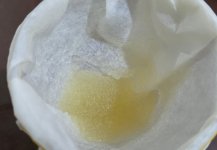
1000075208.jpg


For the second attempt, I still did the microwave cooks but with no acid, and I performed the pulls at room temp. The pulls came out darker in color. And now after basing and letting it settle in the freezer for a day, it is still cloudy. I will seperate the alcohol and put it back in the freezer until I can continue working on it. I plan to evap it and then maybe perform a water wash, hopefully this time without the calcium acetate thing would be better. Any thoughts on ways to proceed to minimize the contaminants?

Regarding the contaminants calcium carbonate and calcium tannate, it does seem concerning to smoke that according to the LLM. I assume the contaminants profile of the ecotek extract is the same and people have smoalked it, so I am not sure how concerned I should be.
Edit: the ecotek uses sodium carbonate so things are different there.

One more thing, when I was drying the 0.35 g goo, at the end I placed the dish on the hot oven exhaust to finish the drying. It got very hot very quickly, I was gone for 1 min and it started smelling like burnt dmt. Although there was no visible vapors coming out of the dish, I am thinking the dmt started to oxidize, so is the nasty smell that of the dmt oxide?

 
Last edited:
roughly 40-50% ethanol
40% is apparently the optimal concentration for tannin precipitation. Why not start directly with a 40% ethanol solution instead? As water is a good solvent too.

Thank you for sharing so detailed notes on the process!

I'm sure Transform will be able to advise you about how to proceed, and about any potential dangers of calcium acetate. While I'm sure it's not too healthy to smoke, smoking anything by combustion is unhealthy. So my concern would be if it's particularly worse than smoking the compounds found in typical changa plants.
 
Back
Top Bottom