• Members of the previous forum can retrieve their temporary password here, (login and check your PM).

~Phalaris = The Way Of The Future~

Migrated topic.
ChatGPT's assessment, partially based on this:
justdontknow.gif


Barnes, R., Simons, A., & Marten, G. (1971). Evaluation of Selected Clones of Phalaris arundinacea II. Indole Alkaloid Derivatives1. Agronomy Journal, 63, 507-509. doi:10.2134/AGRONJ1971.00021962006300030048X

Phalaris arundinacea has very low overall tryptamine content compared to plants like Acacia or Mimosa.

From their results:

5-MeO-DMT was the dominant tryptamine in all clones, but even in the unpalatable ones it only reached ~0.07% of dry weight (700 µg/g).

DMT itself was present only in the unpalatable clones, and at ≤0.02% (200 µg/g).

Gramine, a non-psychoactive indole alkaloid, dominated in the palatable clones (up to 0.1%), with no DMT detected there.

So, relative to Acacia confusa (where DMT can be ~1–2% and 5-MeO-DMT is trace), Phalaris is:

Low in total alkaloids (≤0.1% overall)

Mostly 5-MeO-DMT in the unpalatable types

Nearly negligible DMT levels

• And the alkaloid mix shifts depending on the clone and growing conditions
It's not like it has surfaced any new information. That's why there's a breeding program. Furthermore, @neurobloom has found a cultivar with up to 0.4% 5-MeO-DMT, and it can be smoked directly with clear effects.
 
ChatGPT's assessment, partially based on this:
justdontknow.gif
ChatGPT has not understood this work. The point is that Phalaris is diverse, especially self-incompatible species like P. arundinacea. So while most Phalaris individuals are not useful sources of psychedelic tryptamines, a few are. Our goal is to find, clone, breed, and generally improve those. The chatbot's assessment hints at this possibility in its last line, but the rest of it misses that point entirely.

Trout's Some Simple Tryptamines makes this very clear, noting on page 27 that DMT is "present in SOME strains of P. arundinacea but not in most". We expect that most individuals--and thus most samples in the literature--will be useless, in the same way that most Malus spp. will lack the pleasing texture of a Honeycrisp apple.

The observed psychoactive effects of Phalaris extracts are due primarily to the usual psychedelic tryptamines. Named clones have been selected for tryptamine content, confirmed by laboratory analysis. Other constituents including beta-carbolines may contribute both desired and undesired effects, but less is known there. @Grasshoppers and @neurobloom found a poisonous clone with unidentified TLC spots that fluoresce like a beta-carboline. I'm not aware of any other beta-carboline-related Phalaris bioassays.

I believe that Phalaris is currently the easiest natural source of 5-MeO-DMT. I purchased a P. brachystachys with reliable alkaloid profile from seed, around 1% dry weight grown indoors. @Grasshoppers et al. have collected reliable P. aquatica clones from nature. I don't believe it's an easy source of DMT yet; but that's primarily due to the potential presence of undesired constituents (including 5-MeO-DMT), not the absence of the desired one.

ChatGPT is good for mainstream scientific topics, though even then it sometimes makes up nonsense so all claims should be confirmed with actual sources. At the edge of published knowledge--which is where we're trying to work--it may still be useful, but only with understanding that almost everything it returns will be misleading or outright wrong.

I'm sorry if this comment reads harshly, but I've seen an alarming amount of chatbot output posted on this site as if it's inherently credible, by many different users. This particular output is at least harmless, but this is an area where mistakes can result in severe poisoning or death. We need to be warned and warn others.
 
I’m mostly after 5-MeO-NMT when it comes to Phalaris arundinacea.

Plus what about the beta carbolines?
5-meo-nmt according to the TLC analysis results collaborative from the recent breeding project suggests its a common alkaloid in phalaris aquatica and has shown up more than a few times in cultivar Tanit ( we can refer to it as a cultivar at this point just as much if not more reflective to the term cultivar than cv Australian since it has shown time and again more uniform profile on TLC than cv Australian as 5-meo-dmt dominant)

This might be still spéculations but we noticed that molder Tanit extracts often has the plausible 5-meo-nmt at high proportions compared to cleaner 5-meo-dmt more potent profile extract batches.

I have reported on this thread before that these milder harvest batches occur during the coldest days of winter (usually around December in the southern Mediterranean basin where I'm located at temperatures around 12/6° day/night.

If 5-meo-nmt is what you're after I think you definitely should get some hold of Tanit seeds!

Chag gbt is still stuck at gramine os a toxic dangerous alkaloid more than 5-meo-dmt for god's sake...and every Time i confront it with facts about gramine from my own experimentation and literature it quickly apologizes and loosens it's views om gramine 🙄

I definitly don't recommend chat gbt to study phalaris for a beginner. Chat gbt learns from me about phalaris not the other way.. it quickly resorts to asking questions rather than providing answers when it Comes to this topic.
Exactly 4 consecutive seasons Smoking gramine containing Tanit extracts and my life has never felt better although all the shit I've been going through (more shit than i ever had to deal with in my entire life)

I wouldn't say any phalaris aquatics is safe but I'd definitely defend that some strains/cultivars are safe.

I have unknowingly helped promote the phalaris toxicity hype by the posts I've shared on the Nexus thanks to my limited knowledge and experience with pure 5-meo-dmt effects. It is my responsibility now to fix that misinterpretation. I have simply abused Tanit extracts to the point i had a very rough push back (anxiety, PTSD like symptom from poorly integrated breakthroughs, sleep disorders and extreme psychosomatic unfortunate effects that were precipitated from 5-meo-dmt reactivations. Which I have finally faced and integrated and finally I'm ready to delve back into that world again after actual integration work.

The best thing I've ever done in my entire life to improve my self was discovering this aquatica strain through trial and error and challenging the phalaris gramine toxicity hype!. I think it's time to put this out here with zero doubt!
 
Gramine in excess may blunt tryptamines' effects. Other than that, I have encountered countless various toxicity effects from different grasses, and a gramine megadose perhaps is the cause of just one of those toxicities. I stopped thinking about gramine when it comes to toxicity from grasses a long time ago. These plants are highly complex in constituents and we pretty much don't know anything about the effects of many of their components, more so in combination with an maoi. Safe strains and safe extractions also exist, of course.

Careful with the 5, friends. I was infatuated with it for a while, but switched back to working with purely N,N as I finally realized that 5 does not really synergize with rue, just gets potentiated and dominates it, and DMT is called the spirit molecule for a reason.

Don't traumatize yourself. Stay grounded. Stay integrated.
 
Last edited:
Gramine in excess may blunt tryptamines' effects. Other than that, I have encountered countless various toxicity effects from different grasses, and a gramine megadose perhaps is the cause of just one of those toxicities. I stopped thinking about gramine when it comes to toxicity from grasses a long time ago. These plants are highly complex in constituents and we pretty much don't know shit about the effects of a big amount of their components. Safe strains and safe extractions also exist, of course.

Careful with the 5, friends. I was infatuated with it for a while, but switched back to working with purely N,N as I finally realized that 5 does not really synergize with rue, just gets potentiated and dominates it, and DMT is called the spirit molecule for a reason.

Don't traumatize yourself. Stay grounded. Stay integrated.
I would argue that even synthetic 5-meo-dmt is hugely beneficial even if it seems traumatizing at breakthrough doses if appropriate intergation work is practiced...

When you're trapped in those reactivations you have no other options but to learn to integrate or loose our sanity you're forced to do the real work that comes post the experience not the experience in itself.
 
It is a goal of mine to grow the tanit cultivar. I’m not so up on what’s going on with all that outside of this forum so I just don’t have seeds.

I still do collect and use a bit of wild arundinacea as I am under the impression it often has 5-MeO-NMT more so than DMT/5-MeO-DMT. I have no idea what’s really in them however I just go off the one analysis done on the wild grass I harvested.

I have always enjoyed the extracts. It’s just not DMT or 5-MeO-DMT.

Yugo red I have quite a bit of and even though it’s super low yielding I still extract it every summer and I like it’s effects. I’m halfway through an extraction on 200g dry atm. I won’t get much but I appreciate its effects anyway.

I have some individual seed grown aquatica plants as well as some multi seed patches. Not expecting anything super clean from them but might as well try. It’s nearly impossible to get seeds of named strains.
 
I have unknowingly helped promote the phalaris toxicity hype by the posts I've shared on the Nexus thanks to my limited knowledge and experience with pure 5-meo-dmt effects. It is my responsibility now to fix that misinterpretation.
Are you thinking that incident with the suspected beta-carboline strain might have just been a 5-MeO-DMT overdose? That would put you in good company if yes; among others, Shulgin et al. seem like they came rather close to killing someone per the TIHKAL entry. I've managed to avoid that myself, but my use is at the high end of what most people would consider a microdose. I don't think Phalaris is a specially dangerous source of tryptamines, just that 5-MeO-DMT is a specially dangerous tryptamine.

For anyone new here, most Phalaris seed in commerce has been selected for use as pasture grass. This usually means low tryptamines, at least since they taste bad, and also since they might contribute to the "Phalaris staggers", a cause of livestock illness and death that's still poorly understood but often attributed to some kind of alkaloid poisoning.

This means wild types are usually better, and @neurobloom lives in the region where Phalaris mostly evolved, which thus exhibits maximum genetic diversity. There are naturalized populations of Phalaris all around the world, including near me; but since those grew from small populations of imported seeds, that genetic bottleneck leads to lower diversity. @Grasshoppers has been analyzing by a novel TLC method using the natural fluorescence of the indole alkaloids, and they probably have the biggest collection of Phalaris targeting high alkaloids in the world.

Gramine has often been cited as a toxic hazard, but milligram for milligram it's much less dangerous than 5-MeO-DMT. Minor gramine (or other) impurities can be removed by crystallization, though I don't think it matters much. All common extraction solvents pull gramine in roughly equal proportion to the desired tryptamines, including d-limonene and naphtha. Tyramine is reported in some varieties, but typical extractions should reject it and it's not that toxic either.

Since DMT is relatively much less toxic and used at higher doses, potential impurities including but not limited to 5-MeO-DMT present much higher risk. A user who thinks they're taking 10 mg 5-MeO-DMT but actually gets DMT will be disappointed, but a user who thinks they're taking 100 mg DMT but actually gets 5-MeO-DMT might be dead. That said, as long as each new batch is treated as if it's pure 5-MeO-DMT until proven otherwise (by lab analysis or self-experiment at low dose), I don't think the risk is much worse than other activities discussed here.

Most named varieties are traded as clones and not seeds, since it's easier to get a stable clone than stable genetics from seed. @neurobloom - Have you studied the alkaloid profile of seed-grown 'Tanit' descendants yet? I guess the best outcome would be consistency across individuals, but that would take some luck since I don't believe you've deliberately inbred yet. Even without that, the average alkaloid profile over the population would be valuable information--if that's good and stable over generations, then you might not care that the individuals vary.
 
Yes, we've tested over 30 Tanit plants grown from @neurobloom s seeds. All of them yielded 5-MeO-DMT as the main alkaloid, with consistently low levels of beta-carbolines. While potency varied somewhat, Tanit remains the most consistent strain of Phalaris aquatica we’ve encountered so far.

We haven’t studied Phalaris arundinacea as thoroughly, but my impression is that it shows stronger fluctuations in alkaloid profiles in response to environmental factors. Beta-carboline levels can be significantly higher than in Phalaris aquatica.

I strongly disagree with the claim that P. arundinacea is generally lower in tryptamines than P. aquatica. In my experience, tryptamine content varies greatly depending on the season, microclimate, and the specific local variety.

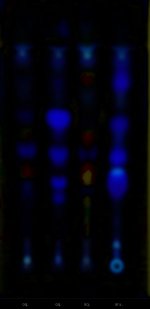
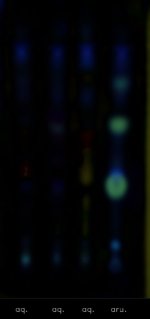
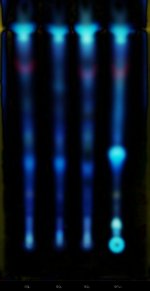
In the TLC plate shown below, there are three P. aquatica samples and one P. arundinacea sample. In this specific P. arundinacea, 5-MeO-NMT is the dominant alkaloid (visible in the 275 nm dry image), while two strong, unidentified beta-carboline signal are also present (365 nm wet image).

Overall, P. arundinacea has proven to be unpredictable - its beta-carboline levels can surpass anything we've observed in P. aquatica. Only Phalaris coerulescens shows more extreme variation.


2024.09.05 (275nm) wet.jpg
275nm wet plate


2024.09.05 (275nm) dry.jpg
275nm dry plate


2024.09.05 (365nm) wet.jpg
365nm wet plate
 
Last edited:
I have wondered if it would be possible to activate oral DMT with extracts of wild arundinacea from this region. It’s not something I care to try out personally however.
This would require an additional research project into the β-carboline profiles of these grasses. Of course, there are other grasses, sedges and rushes which may contain suitable alkaloids. Making some sort of "graminhuasca" seems an entirely plausible possibility, whether that would be from a single plant or, more likely, from a combination of grasses.
 
To me it seems like it's a slim chance to encounter a beta carboline profile in a grass that has maoi properties on par with rue or caapi and doesn't pose toxicity in the required doses to fully activate DMT. Perhaps not impossible. But discovering such a grass is difficult to say the least. I appreciated the plant teacher vibes from beta carbolines in Phalaris truncata and in dried phragmites leaves. I just don't have the incentive to research into maoi substitute possibilities. If anyone does, please go ahead.
 
This autumn I'm starting an additional large feild plot on a new farm for selective breeding of all the wild accessions and cultivars we have collected from across the world and of course i will start TLC.

The favorable Mediterranean climate and large available farming space will provide an additional opportunity to select for agronomic performance not just profile and yield.

This will help us create entheogenic cultivars for Mediterranean like climates around the world (drought and salinity tolerance, early flowering and pronounced summer dormancy) like new south Wales, south Africa, middle east, California, and the Mediterranean basin of course. Basically the same locations where aquatica is already a forage crop.

I will Still keep growing Tanit on a different farm where it has already established well. We can expect a couple kilograms Tanit seeds by next May. And maybe 50g or so of grasshoppers selected hybrid seeds.

Edit:
This isn't just a parallel selective breeding operation to speed up the project but it will provide a path for a different phenotypic selection suited to warmer Mediterranean like climates.

That is to say an entheogenic selected cultivar bred in central Europe as is the case for grasshoppers may not exhibit the same performance, profile and yield if grown in a Mediterranean like climate and vice versa. Hence why it's important to do parallel selective breeding operations at different parts of the world to ensure performance consistency.

Tanit seems to be an exception in this case though as it proved to exhibit the same profile and yields when grown in north Africa as in central europe and Queensland Australia.
 
Last edited:
Speaking of toxicity, just wanted to mention that with all my experiments through all the years, there seems to be a generalized pattern of much greater toxicity in earliest growth, and the toxicity reaching it's minimum by the flowering phase across all the species I have studied. As an example, the truncata leaves I mentioned in my previous post presented as a soft, benign, wise and intelligent teacher (most likely beta carbolines) at the beginning of the flowering phase, with AND without rue. When I tried it's earliest growth after the fall rains with rue, it was a complete energetic chaos, poisoning my consciousness, and also brought me to a physically very dangerous feeling state, and it was not just the 5-MeO-DMT overdose's effect on the heart.
 
The β-carbolines observed on the TLC above should be 2-methyl-1,2,3,4-tetrahydro-β-carboline (Frahn et al., 1971; Gander et al., 1976) and 6-methoxy-2-methyl-1,2,3,4-tetrahydro-β-carboline (Frahn et al., 1971). Youdim, 1981 noted that 2-methyl-1,2,3,4-tetrahydro-β-carboline is the most potent β-carboline in terms of MAO-A inhibition. @Jamie01, I would therefore strongly expect that specific strains of Phalaris arundinacea can produce psychedelic effects when consumed orally, on their own, without other ingredients.

Toxicological data on these β-carbolines is limited. We must be cautious not to assume they are non-toxic simply because they may occur in ayahuasca. 2-methyl-1,2,3,4-tetrahydro-β-carboline is identified only in trace amounts, particularly in P. viridis and/or brews made with it (Schultes, 1957; Callaway et al., 1999; Rivier & Lindgren, 1972; McKenna et al., 1984; Rodríguez L, 2023).
6-methoxy-2-methyl-1,2,3,4-tetrahydro-β-carboline could occur in B. caapi, particularly in chemotypes rich in methoxylated β-carbolines, but its presence and concentration have not been definitively confirmed.

N-methyltetrahydro-β-carboline analogs of the neurotoxin 1-methyl-4-phenyl-1,2,3,6-tetrahydropyridine (MPTP) are oxidized to β-carbolinium cations (2-Me-DHBC+/2-Me-BC+ and 2,9-diMe-DHBC+/2,9-diMe-BC+) by heme peroxidases (Herraiz T., 2007), which are potential neurotoxins.

Safety is paramount, and due to the risk of permanent nigrostriatal brain damage associated with unknown β-carbolines, I strongly discourage anyone from consuming extractions of Phalaris or related Poaceae such as Phragmites without proper testing.

@neurobloom, I’m really glad to hear that you will begin performing TLC. I look forward to your personal correspondence on this issue. While there is a lot of anecdotal knowledge, testing is the right way to make real progress in this area of research.
 
Last edited:
In The Entheogen Review, vol. XI, number 1 (2002) there is an interesting interview titled "Johnny Appleseed Speaks..." where said "Johnny Appleseed" talks about his Phalaris cultivars Turkey Red (high in 5-MeO-DMT) and Big Medicine (high in DMT). Does anyone know what came to be of those cultivars? Were they lost?
 
Speaking of toxicity, just wanted to mention that with all my experiments through all the years, there seems to be a generalized pattern of much greater toxicity in earliest growth, and the toxicity reaching it's minimum by the flowering phase across all the species I have studied.
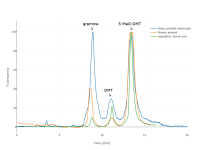
On that subject, here are superimposed chromatograms of P. brachystachys extract at different life stages: purely vegetative growth with leaves only, reproductive growth with flowers present, and a dying plant after flowering that had begun to naturally desiccate despite normal irrigation. The vertical axis has been normalized to the same maximum height for all three.

ph9-life-stages.png

We get purest 5-MeO-DMT before flowering. Gramine increases with time, eventually becoming the dominant alkaloid by fluorescence height. I don't have a gramine standard, so I don't know how that maps to mass. I unfortunately didn't keep good enough notes to report the absolute concentrations, but I recall that the concentration of 5-MeO-DMT decreased with time.

I don't know how this would affect the subjective experience since I didn't consume these unpurified. The answer here may just be "not much", given gramine's general inertness in these relatively low doses. Other species or varieties may be completely different, and the diversity of Phalaris is both its promise and its challenge.

I'm very happy with the variety of P. brachystachys that I'm working with. I wish it had a name; the seller didn't identify it beyond the species. A patch of 2-3 square feet outdoors yields about 1000 g fresh weight per month, which yields about 200 mg 5-MeO-DMT. The same seed grown hydroponically indoors is about 5x as strong.

For completeness, I've tried and failed repeatedly to crystallize 5-MeO-DMT succinate. This is reported in the literature, but the same conditions that successfully crystallized the oxalate didn't work, plus various other attempts. My resin was much more soluble in ethanol than that paper's supplementary materials implied it should be. I guess that might be residual water as a cosolvent; perhaps it would have worked if the resin had been dried hotter or under vacuum, or perhaps a natural impurity inhibits crystallization (since the impurity profile of their synthetic product would be completely different).
 
Hm, interesting - given the peak broadening and raised baseline on the 'dying material' result, I'd infer that the absolute level of 5-MeO-DMT was lower than in the other two samples. It also looks as though the vegetative phase sample has the highest absolute concentration of alkaloids. Is the shouldering perhaps the result of the presence of things like 2-MTHBC derivatives, and the N-monomethyl tryptamines? I can imagine that some of these analogues might be quite difficult to separate from the target compounds. Do you know if the fluorescence detection system would have any way of distinguishing them?

Presumably there's a solvent system or column medium that could afford a better separation. What is the likelihood that it's something like 6-methoxy-2-methyltetrahydro-β-carboline that's upsetting your crystallisation attempts?
 
Hm, interesting - given the peak broadening and raised baseline on the 'dying material' result, I'd infer that the absolute level of 5-MeO-DMT was lower than in the other two samples.
You infer correctly, around a tenth of the other two. I have the raw chromatograms. I just failed to record the dilutions, and those aren't exactly comparable since I didn't always use the same ratio of water to grass when I extracted. I think it's probably something like 200 ug/g fresh for vegetative, 150 ug/g when flowers are present, 20 ug/g dying, but that's my fuzzy memory so don't trust it too much.

Is the shouldering perhaps the result of the presence of things like 2-MTHBC derivatives, and the N-monomethyl tryptamines?
I think the shoulder is just an artifact of the low amplitude, detector nonlinearity near the bottom of its range. I try to keep my injections dilute to extend column life, so when the concentration is unexpectedly low there's almost zero signal. I unfortunately discarded that sample, so I can't repeat the injection at lower dilution.

In a previous experiment, I found that with this HPLC method, mixed harmalas do not elute. That leads me to suspect most beta-carbolines will be well-separated, though I'll leave to others the question of what substituents might change that. It's a phenyl-hexyl column, so we must consider both polarity and pi-pi interactions. I haven't done TLC much since I got my HPLC working, but I don't recall any fluorescent spots under longwave UV back then. So I suspect that my P. brachystachys is low in beta-carbolines.

In that experiment I got ~20x the fluorescence signal per unit mass from my mixed harmalas vs. mixed tryptamines, and I think if I'd been smart then I'd have chosen a higher excitation wavelength (I used 300 nm) and seen a yet higher ratio. So I think I should be able to detect any significant beta-carboline constituents, unless they're active in sub-milligram doses. I just can't do them in a single isocratic HPLC method, since any eluent weak enough to separate DMT and 5-MeO-DMT is too weak to elute the harmalas at all.

I don't have any NMT, but that barley breeding paper used a similar method, their Figures S4 and S5. It showed NMT (they call it MeTRY) eluting just after gramine with some overlap, so I guess that's pretty far from my 5-MeO-DMT. Their method isn't identical though, ACN instead of MeOH, formic acid instead of phosphoric, a different brand of column, a gradient and not isocratic. They didn't do any other N-monomethyl tryptamines. It's too bad I can't order from Cerilliant.

That’s a pretty darn good yield… thats maybe 100g dry brachys? .2% 5-MeO-DMT is excellent!
I'm really pleased with it. Perhaps I just got lucky, but I think it's more likely they're the result of an unknown human's selection, since I bought them from a seller specializing in entheogenic plants. It's probably around 100 g dry. I usually extract the fresh (well, frozen) grass into water, but I've tried drying a few times and averaged 8.4:1 fresh:dry.

The hydroponic grass is even better, approaching 1% dry weight. I think that's due to stress, since growth is actually slower there and the leaves are thinner and narrower. I don't understand what kind of stress, though. I think it's also lower in sugars, since the extract doesn't get so syrupy when reduced. That stuff is great, much less painful to extract. I should try to understand and improve what's happening there.

P. brachystachys may be generally preferable for indoor growing, since I've confirmed it can complete its life cycle and set viable seed without any seasonal cues, under constant temperature and day length. P. aquatica may be preferable for outdoor growing, since it may require seasonal cues per @Grasshoppers's trouble. It should put on mass faster though, and the greater genetic variation gives more prospect for high alkaloid levels with proper selection.

It would be very interesting to see absolute numbers from @Grasshoppers et al. I know you've mentioned you don't have proper standards, but the material you crystallized from a Phalaris extract earlier in this thread seems more than pure enough to provide useful information. If in doubt you could send your standard for external lab analysis too.
 
Back
Top Bottom