• Members of the previous forum can retrieve their temporary password here, (login and check your PM).

TEK "TnT tek" - Vodka DMT extraction for oral use TEK (super easy!)

This topic contain a TEK
Well, although I never took it as far as correcting the volume to standardise the dosing (which would be sensible), it would be quite viable just to use vodka if your material was evaporated down to an essentially solid mass, but I'd consider using higher-proof alcohol if it was only partly evaporated down to a liquid, since alcohol evaporates faster than water.
very much appreciated. i'll build a statue in your honor in the dmt world :)
 
I just concluded my second test with this first run (using different batches of caapi) and it appears i messed up somewhere as I can barely feel the dmt at a 7g dose (plus 5g 1hour later). The only variation from the tek was that i couldn't figure out how to effectively filter the sludge, so I just decanted the clear liquid. Otherwise I followed it exactly (leaving the MHRB in vodka for 3 days or so). This was using a known strong batch of MHRB. Any thoughts appreciated, thanks.


"Freebase DMT is highly insoluble in water. Because vodka is 60% water, raising the pH actually forces a large portion of the DMT out of the liquid solution, causing it to trap itself in the sludge at the bottom." Don't know if it's true or not, but this may explain it. That sludge is really not filterable...
 
Last edited:
Freebase DMT is highly insoluble in water. Because vodka is 60% water, raising the pH actually forces a large portion of the DMT out of the liquid solution, causing it to trap itself in the sludge at the bottom." Don't know if it's true or not, but this may explain it. That sludge is really not filterable...
I'm guessing that's a LLM ("AI") output. Practical experience shows that DMT freebase is highly soluble in vodka.

How much lime, proportionally, did you use?
 
I'm guessing that's a LLM ("AI") output. Practical experience shows that DMT freebase is highly soluble in vodka.

How much lime, proportionally, did you use?
ok, cool. I used 115g of lime. The solubility of dmt in vodka wasn't at question, but the pickling lime converts the dmt into freebase which is hydrophobic, and since vodka is largely water there is a repelling force driving it towards the oils, waxes, solids, etc... That's the theory at least, i know nothing about any of this.

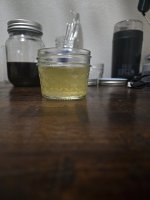
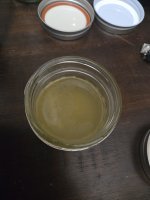
Everything looked exactly like the pictures posted by Ambrosaure. I'm assuming you've read through his write up and all is as it should be. it's a remarkably simple tek, so i'm not sure on how/where it could have gone wrong.
 
Last edited:
ok, cool. I used 115g of lime. The solubility of dmt in vodka wasn't at question, but the pickling lime converts the dmt into freebase which is hydrophobic, and since vodka is largely water there is a repelling force driving it towards the oils, waxes, solids, etc... That's the theory at least, i know nothing about any of this.

Everything looked exactly like the pictures posted by Ambrosaure. I'm assuming you've read through his write up and all is as it should be. it's a remarkably simple tek, so i'm not sure on how/where it could have gone wrong.
I'm not sure either. The method still counts as experimental, and @Ambrosaure's version is but one iteration of the overall principles. Did you wash your solids with a bit of extra vodka after the first filtration? The strength of partition into nonpolar material hasn't been determined but the following points all apwly:
  • there's not much oil/waxy stuff in MHRB anhow;
  • the initial vodka pulls would select against oily material to a large extent; and
  • DMT FB really is exceedingly soluble in vodka, so partition into that phase seems favourable.

    There may be some requirement to take into account the formation of water from the reaction of hydroxide in the lime with the protons from the DMT salt form and any other protonated bases as well as the various tannins. Even so, it will be an absolute maximum of 16/37 of your lime quantity, or about 1840 × 0.027027… = 23 × 8 × 0.27027… = 23 × 2.16216… = 48.3 + (1.15 + 0.23) + 0.046 + 0.0023 + (0.00115 + 0.00023) + … ≈ 49.73 mL water.

    The significance of this depends on the volume of vodka used, and was part of the rationale behind freezing the excess water out of the solution aprés lime treatment - even if that stemmed from a failed attempt at freeze precipitation of the DMT. Water is "less soluble" in the detanninised mimosa tincture than the organic components at freezer temperatures, while it was possible to get already purified DMT to crash as an (ethanol rich?) oil from aqueous ethanol at similar temperatures without ice formation being observed.

    But that's its own tangent here, stemming from the aforementioned dilution factor - the impact of which depends on the amount of vodka being used.
    second test with this first run (using different batches of caapi)
    Is it possible that the caapi was weak, or have you successfully tested it with a less experimental, more reliable DMT source?
 
I'm not sure either. The method still counts as experimental, and @Ambrosaure's version is but one iteration of the overall principles. Did you wash your solids with a bit of extra vodka after the first filtration? The strength of partition into nonpolar material hasn't been determined but the following points all apwly:
  • there's not much oil/waxy stuff in MHRB anhow;
  • the initial vodka pulls would select against oily material to a large extent; and
  • DMT FB really is exceedingly soluble in vodka, so partition into that phase seems favourable.

    There may be some requirement to take into account the formation of water from the reaction of hydroxide in the lime with the protons from the DMT salt form and any other protonated bases as well as the various tannins. Even so, it will be an absolute maximum of 16/37 of your lime quantity, or about 1840 × 0.027027… = 23 × 8 × 0.27027… = 23 × 2.16216… = 48.3 + (1.15 + 0.23) + 0.046 + 0.0023 + (0.00115 + 0.00023) + … ≈ 49.73 mL water.

    The significance of this depends on the volume of vodka used, and was part of the rationale behind freezing the excess water out of the solution aprés lime treatment - even if that stemmed from a failed attempt at freeze precipitation of the DMT. Water is "less soluble" in the detanninised mimosa tincture than the organic components at freezer temperatures, while it was possible to get already purified DMT to crash as an (ethanol rich?) oil from aqueous ethanol at similar temperatures without ice formation being observed.

    But that's its own tangent here, stemming from the aforementioned dilution factor - the impact of which depends on the amount of vodka being used.

    Is it possible that the caapi was weak, or have you successfully tested it with a less experimental, more reliable DMT source?
Appreciate those thoughts. I used 2 different batches of caapi tincture (first attempt with yellow caapi and the second with black). I'd tested the black one with my changa and it was highly activated to say the very least 🚀

I did NOT do a wash on the sediment. I tried to filter it and things got a bit out of hand. Until some tests can be run I think we may want to at least change some of the wording in the tek writeup relating to importance of the final wash. I'd be happy to do another run at it with that in mind this weekend. Do a few washes at the end and be a bit more focused on the sediment layer.

Both attempts used over 10g each and I felt next to nothing besides the caapi. Which is to say, that most of the dmt must have been hiding in the foliage, at least that's how it appears.
 
Last edited:
@Transform @blig-blug

So I ran another batch of this. After the initial soak I filtered out the marc using a nut bag followed by a micro mesh for pour over coffee.
Then I introduced the lime, waited for it to separate, decanted the clear yellow layer, ran the grey muck through the same filtration process (nutbag + pour over mesh). I washed the filtered gunk with another round of vodka and filtered all of that. I combined all the filtered liquid and now have a slightly creamy looking coffee solution not at all transparent. If it let it sit for a bit about 1/4 of it turns transparent at the top. All in all I spent a couple hours filtering....

The solution i now have is thicker than the 1 i had prior to stirring in the lime. Which makes me wonder if there is lime in it, of course, binding things up still. Exactly how much needs to get filtered out? I do not think a paper filter would be possible, the mesh barely was. Some insight here would be deeply appreciated. I followed the directions to the letter (which does not properly address the task of filtering). I'm not sure if i've gone overboard with the filtering process due to concerns or if I should do another round of lime and even more filtering. If the latter, what amount of lime makes sense?

I was hoping to test this tomorrow but it may not be ready (or it's already done and I don't know).

🙏
 
Did you dump the lime in all in one go or add it bit by bit?

It's hard to overemphasise the importance of adding the lime in slow increments. Avoiding an excess of lime is paramount to keeping the separation phase as smooth as possible. You may need to use less lime - and if your current process, as it would appear, now has too much lime in it, you may want to consider 'back-titrating' it with a further amount of bark tincture.

There's an ideal end-point where the intense red colour fades to orage-yellow. Allowing a certain amount of reaction time is also desirable on account of the lime's poor solubility.

It is almost certainly necessary to take into account the natural variation between different batches of bark and thus remain vigilant at this experimental stage for signs of anomalous behaviour.
 
This is not a case of user error as far as I can tell, the tek is incomplete and lacking detail. I added the lime extremely slowly and stopped at 100g. If you look at the pictures by the OP, the only possible outcome of filtering the sediment layer is my current status. No worries, i'm just going to abandon this and start working on something else.

edited: i just looked in on it after letting it sit all night and it has gone through a whole other separation phase. There's 5% of sediment on the bottom and 95% clear yellow solution (about 700ml of clear from total of 1250ml). So, that seems like a possible success to me, what do you think?

I gave the solution about 4 hours to separate after stirring in the lime, initially. It might have made more sense to just do a nut bag strain at that time (4 hours in). wash the filtered weirdness with a bit more vodka. add the wash to the rest of the solution, let it sit overnight, decant + then do a major filtering. That will take longer, but with considerably less effort in terms of straining.
 
Last edited:
the tek is incomplete and lacking detail
Maybe, as there isn't an "official" write-up yet. Howeer the tek is quite simple, so I'm not sure what detail may be missing.

I added the lime extremely slowly
While stirring?

There's 5% of sediment on the bottom and 95% clear yellow solution (about 700ml of clear from total of 1250ml).
I think so. I'd let it sit in the fridge for a while if you are worried about it.

I gave the solution about 4 hours to separate after stirring in the lime, initially. It might have made more sense to just do a nut bag strain at that time (4 hours in). wash the filtered weirdness with a bit more vodka. add the wash to the rest of the solution, let it sit overnight, decant + then do a major filtering. That will take longer, but with considerably less effort in terms of straining.
I'm unconvinced filtering the sediment instead of decanting (at first) makes sense at all. I decant (running the clean liquid through a filter just in case) and wash the sediment with fresh vodka afterwards, never filtering the sediment. That takes less than half an hour. If you try this tek again, I recommend doing it that way.
 
While stirring?
indeed. 20g at a time, stirred for 20 seconds

I think so. I'd let it sit in the fridge for a while if you are worried about it.
it's looking crystal clear after my filtration steps, so feeling good about it, thanks.

At this point stop adding lime and wait couple of hours
I think the less lime you use the longer separation takes. I was quite careful this time not too add too much (i used 100g compared to last time at 115g) after waiting a 'couple of hours' i had about 100ml of transparent yellow floating on top. After 4 hours I had about 150ml of transparent yellow. If i had left this to settle overnight at this stage I'm guessing my experience would have been more like yours, maybe. But I wasn't sure that I could leave the lime in for that long. Can i?

I'm unconvinced filtering the sediment instead of decanting (at first) makes sense at all. I decant (running the clean liquid through a filter just in case) and wash the sediment with fresh vodka afterwards, never filtering the sediment. That takes less than half an hour. If you try this tek again, I recommend doing it that way.
well, given your experience I can see why you'd be hesitant. But that hasn't been my experience. And, actually, this is exactly what i did on this run. The problem was that the vast majority of what i was working with was sediment and every wash i performed resulted in a coffee milkshake that then needed to go through another separation and filtration. What process were you using to wash?
 
Last edited:
it's looking crystal clear after my filtration steps, so feeling good about it, thanks.
Glad to hear that it turned out okay.

But I wasn't sure that I could leave the lime in for that long. Can i?
Yes, there is no problem at all.

The problem was that the vast majority of what i was working with was sediment and every wash i performed resulted in a coffee milkshake that then needed to go through another separation and filtration. What process were you using to wash?
I just added vodka to the sediment, stirred, and waited again for it to decant. It's surprising that in your case it created a kind of emulsion, in my case it separated quite fast. I wonder if it could be related to different particle size of our lime powder or something like that. It's strange, because the first time I actually used calcium oxide (of a very poor quality) that I converted into calcium hydroxide with somewhat uncertain success, so far from a good quality starting point. And yet it still didn't cause any issue.

I haven't measured how much lime I add, but I'm pretty sure during the first stage (not washing) I add much less than 20g at a time. Next time, I'll measure how much it is, but it's probably just a few grams. In my case it always seems to sink very easily.

Clearly more experimentation is needed to understand what variables cause the difference between getting milkshake-like liquid or it decanting easily.

To make sure, is your vodka around 40% alcohol? I know in the US it can legally be higher, and that could explain the differences.
 
Yes, there is no problem at all.
ok, well, next time I will let it separate overnight. I'm guessing that for you the sediment was a relatively small percentage of the solution?
I just added vodka to the sediment, stirred, and waited again for it to decant. It's surprising that in your case it created a kind of emulsion, in my case it separated quite fast. I wonder if it could be related to different particle size of our lime powder or something like that. It's strange, because the first time I actually used calcium oxide (of a very poor quality) that I converted into calcium hydroxide with somewhat uncertain success, so far from a good quality starting point. And yet it still didn't cause any issue.
and just a single washing then? I had some very strange looking sediment in that first filtration after adding the lime, possibly calcium tannate 🤷‍♂️
I'm using Mrs Wages Pickling Lime. After my first batch was a dud, i, admittedly, got paranoid about the sediment holding on to the dmt, and likely got carried away with filtering...

I haven't measured how much lime I add, but I'm pretty sure during the first stage (not washing) I add much less than 20g at a time. Next time, I'll measure how much it is, but it's probably just a few grams. In my case it always seems to sink very easily.
ok, will go even slower next time.

Clearly more experimentation is needed to understand what variables cause the difference between getting milkshake-like liquid or it decanting easily.

To make sure, is your vodka around 40% alcohol? I know in the US it can legally be higher, and that could explain the differences.
yes, i'm diluting 95% Everclear down to 40% - which i guess is technically different than vodka but same strength. my understanding is that a higher percentage alcohol has a risk of leaving lime behind in the solution...
 
Last edited:
Back
Top Bottom